


Aluminium swing doors are a popular choice for modern homes, commercial storefronts, and industrial buildings. They are lightweight, durable, and resistant to rust. However, anyone who has installed one knows the process isn’t always smooth. From misaligned frames to loose handles, the installation can quickly turn into a frustrating puzzle.
The good news? Most of these headaches stem from one common weakness: surface-mounted handles. By switching to through-bolt handles, you can eliminate these problems before they start.
Below, we break down the five most frequent installation issues and show you exactly how through-bolt technology solves them.
Headache #1: Misaligned Latch Holes That Never Quite Match
The Problem
- You measure twice, drill once, but when you go to close the door, the latch tongue hits the strike plate too high or too low. This is often caused by slight flexing in the aluminium frame during handle installation. Aluminium is softer than steel, so when you tighten surface-mounted screws, the metal can warp just enough to throw off your alignment.
The Solution with Through-Bolt Handles
- Through-bolt handles clamp the door from both sides using a solid bolt that passes completely through the door. This creates even pressure across the entire section, preventing frame distortion. The result? Your latch and strike plate align perfectly every time.
- Pro tip: Always drill a pilot hole all the way through the door before installing the through-bolt. Use a backing block to prevent blowout on the opposite side.
Headache #2: Stripped Screw Holes in Thin Aluminium
The Problem
- Standard self-tapping screws rely on the thin aluminium skin for grip. Over time—or even during installation—these screws can strip out the soft metal. Once stripped, your handle becomes loose, the door rattles, and security is compromised. Replacing the handle often means drilling new holes in an already crowded area.
The Solution with Through-Bolt Handles
- Through-bolts don’t rely on the aluminium’s threading at all. Instead, a machine-threaded bolt passes through the entire door and is secured with a nut on the opposite side. This creates a mechanical lock that won’t strip, even with heavy daily use.
- Key benefit: You can remove and reinstall the handle multiple times without damaging the door.
Headache #3: Handle “Wobble” After Only a Few Months
The Problem
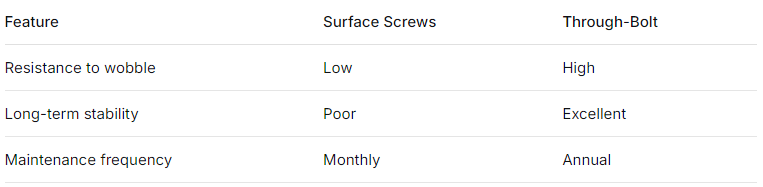
- Surface-mounted handles attached with small screws often develop play over time. Every time someone pulls the door open, the handle levers against those tiny screws, gradually enlarging the holes. Soon, you have a wobbly handle that feels cheap and unreliable.
The Solution with Through-Bolt Handles
- Because the through-bolt compresses the handle sets together under tension, there is no leeway for movement. The handle stays rock-solid even after thousands of cycles. This is especially important in high-traffic areas such as office entrances or patio doors leading to pools.
Comparison:
Headache #4: Difficulty Installing on Glass or Panel Inserts
The Problem
- Many aluminium swing doors have large glass panels or insulated core inserts. With standard handles, you’re limited to drilling into the narrow stile (the vertical edge of the door). If your measurements are off by even 2mm, you risk cracking the glass or breaking the insulation seal.
The Solution with Through-Bolt Handles
- Through-bolt handles are designed for narrow stiles. Because the bolt passes straight through, you can position the handle precisely on the solid frame section without worrying about internal obstructions. Many through-bolt kits also include sleeve spacers that prevent over-compression of hollow sections, protecting glass panels from pressure cracks.
- Installation tip: Use a depth stop on your drill bit to prevent accidentally penetrating too far into a glass pocket.
Headache #5: Security Risks from Exposed Screws
The Problem
- Standard surface-mounted handles with exposed screws are a burglar’s dream. An intruder can simply remove the screws from the outside using a basic screwdriver, pop off the handle, and manipulate the latch mechanism directly. For exterior aluminium doors, this is a critical vulnerability.
The Solution with Through-Bolt Handles
- Through-bolt handles have no accessible external fasteners. The bolt head is either concealed under a decorative rose or requires a special tool (like a hex key) to remove. More importantly, removing the handle still leaves the bolt shank inside the door, making it nearly impossible to access the latch from outside.
- Security upgrade: For maximum protection, choose through-bolt handles with hidden set screws and Grade 316 stainless steel bolts to resist sawing or cutting.
Conclusion: Stop Fixing Symptoms—Solve the Root Cause
The five headaches above—misalignment, stripped holes, wobble, glass interference, and security flaws—all trace back to one root cause: inadequate handle attachment. Surface-mounted screws simply can’t handle the demands of a functional aluminium swing door.
By switching to through-bolt handles, you gain:
- Perfect alignment through even clamping force.
- Permanent grip with no stripped threads.
- Solid feel without wobble or play.
- Glass-safe installation with precision depth control.
- True security with no exposed external fasteners.
Whether you’re a professional installer or a DIY homeowner, investing in through-bolt handles from the start will save you hours of frustration and years of maintenance.
FAQ
Q1: Can I retrofit through-bolt handles on an existing aluminium door that currently has surface-mounted ones?
A: Yes, in most cases. You will need to fill the old screw holes (use aluminium-grade epoxy putty) and drill new 8–10mm holes for the through-bolts. Ensure the new handle’s bolt spacing matches the available solid area of the door stile.
Q2: What tools do I need to install a through-bolt handle?
A: You’ll need a drill with a carbide-tipped hole saw or step bit (for aluminium), a level, a ruler, a wrench or hex key (depending on the bolt type), and a deburring tool to smooth the hole edges.
Q3: Will through-bolt handles work on hollow aluminium doors?
A: Absolutely. Many through-bolt kits include a metal or nylon sleeve that fits inside the hollow section. The bolt passes through this sleeve, preventing the door from being crushed when you tighten the nut.
Q4: Are through-bolt handles more expensive than regular handles?
A: Slightly more upfront (typically 15–30% higher), but they last 3–5 times longer than surface-mounted handles. The reduced maintenance and replacement costs make them cheaper in the long run.
Q5: Can I install a through-bolt handle on a narrow aluminium frame (less than 2 inches wide)?
A: Yes, but choose a compact handle designed for narrow stiles. Look for models with a bolt hole spacing of 1.5 inches or less. Always verify the frame’s internal clearance before drilling.
Q6: Do through-bolt handles require special weather sealing?
A: Good through-bolt handles come with neoprene or silicone gaskets that seal the bolt hole against air and water infiltration. For exterior doors, apply a small bead of silicone sealant around the bolt hole before final tightening.
By addressing these common installation headaches head-on, you can ensure your aluminium swing door operates smoothly, securely, and reliably for years to come.