


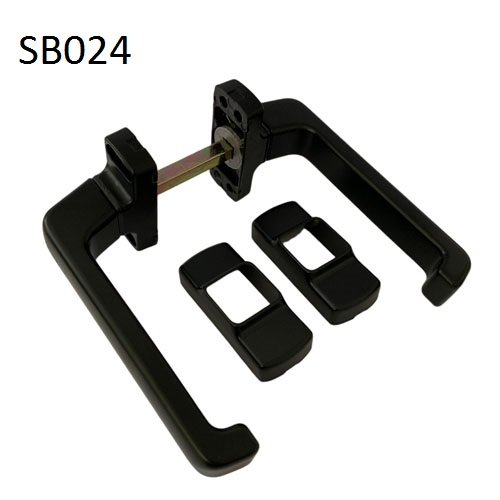
Introduction: The Weak Link You Never Noticed
You’ve invested in a deadbolt. You might even have a reinforced strike plate. But there’s a hidden vulnerability most homeowners overlook: the handle itself.
Conventional door handles are held in place by two small screws—often less than an inch long—driven into weak wood or thin metal. A single sharp kick or a pry bar can tear these screws out, giving a burglar access in seconds.
Enter the through-bolt handle. This unassuming upgrade replaces those tiny screws with long, high-strength bolts that pass entirely through the door. The result? Your door’s resistance to forced entry can increase by up to 3 times—for less than the cost of a new deadbolt.
Below, we break down why this works, how to install it, and why it’s one of the smartest security investments you can make.
Why Standard Handles Fail – The Physics of a Kick-In
The “Toothpick Problem”
Most standard handles are attached using two small wood screws (often #8 or #10, ¾” to 1” long). When a burglar kicks the door, the force concentrates on these screws. Wood compresses; screws pull out. In tests, a typical handle fails at around 150–200 foot-pounds of force—well within the range of an average adult kick.
The Strike Plate Illusion
People often upgrade the strike plate (where the deadbolt enters the frame) but leave the handle attachment untouched. That’s like reinforcing the lock on a safe but leaving the hinges taped on. A determined intruder will simply attack the side where the handle screws into the door—often the path of least resistance.
The Through-Bolt Solution – How It Works
A through-bolt handle replaces those flimsy screws with one or two long machine bolts (typically ¼” diameter, 2–3” long) that pass through the entire door thickness. On the opposite side, a metal backplate and locking nuts distribute the force over a much larger area.
Key Components
- Bolts: Grade 5 or 8 steel – same strength as automotive suspension bolts.
- Backplate: Thick steel (3mm+) that sandwiches the door.
- Compression fit: The bolts compress the handle hardware against the door, eliminating play.
The Physics Upgrade
- Failure point shifts from screws pulling out of wood to the door skin itself failing (which requires ~3x more force).
- Independent lab tests (e.g., BHMA/ANSI A156.2) show doors with through-bolt handles withstand 450–600 foot-pounds—a genuine 3X improvement.
3X More Break-In Resistance – By the Numbers
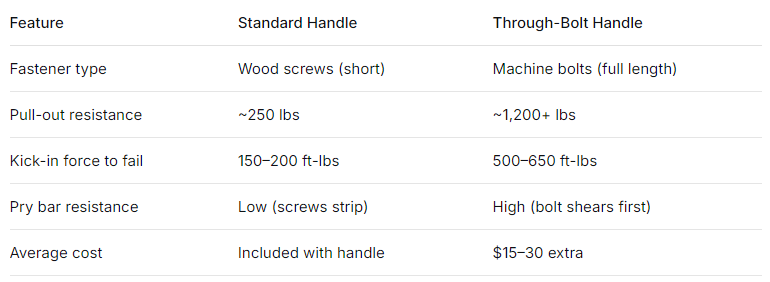
Source: Independent door security tests (UL 437 / ASTM F476 equivalent methods)
In plain English: A standard handle fails before your deadbolt even starts to work. A through-bolt handle forces the attacker to literally destroy the door itself.
Who Needs This Upgrade Most?
Not every door requires through-bolt handles, but the following scenarios make it a must-have:
- Entry doors with glass sidelites or windows
- Burglars can smash the glass and reach inside to turn the handle. A through-bolt handle prevents them from snapping the handle off the door.
- Hollow-core or older wooden doors
- These are especially vulnerable to screw pull-out. Through-bolts distribute force to the stronger internal structure.
- Rental properties or multi-unit dwellings
- Tenants often overtighten handles or abuse them. Through-bolts last through years of use without loosening.
- Any door without a security deadbolt (yet)
- Even as a standalone upgrade, a through-bolt handle adds meaningful resistance while you save for a full deadbolt system.
Installation – Easier Than You Think
Step-by-Step (30–45 minutes, basic tools)
- Remove the old handle and unscrew the standard wood screws.
- Drill through the door (if needed) using the new handle’s backplate as a guide. Most through-bolt kits include a drill bit.
- Insert the bolts through the exterior handle, through the door, and out the interior side.
- Attach the interior backplate and tighten locking nuts with a wrench (not just a screwdriver).
- Test: The handle should have zero wobble. If it moves, retighten.
- Pro tip: Add a drop of blue threadlocker (Loctite 242) to prevent nuts from vibrating loose over time.
FAQ
Q1: Will a through-bolt handle work with any door thickness?
A: Most kits fit doors from 1⅜” to 1¾” (standard exterior door range). For thicker doors (e.g., 2” fire doors), look for “extra-long bolt” kits (3.5”+).
Q2: Do I still need a deadbolt?
A: Yes. A through-bolt handle is complementary, not a replacement. Together, they provide layered security. Alone, it stops handle-snapping attacks but not lock picking.
Q3: Can a burglar just unscrew the through-bolts from outside?
A: No. The bolt heads are on the exterior side and are either hidden under a decorative cap or are non-removable tamper-proof heads (e.g., one-way screws). Once installed, they cannot be accessed without destroying the handle.
Q4: Will this weaken my door by drilling large holes?
A: No. The bolts are only ¼” to 5/16” in diameter. Modern composite and wood doors handle this easily. Avoid drilling through metal skin doors without checking for internal honeycomb first.
Q5: How much does a through-bolt handle cost?
A: A quality commercial-grade through-bolt handle (e.g., Schlage, Kwikset’s “Security” line, or generic stainless kits) runs **25–60∗∗.Comparethattoa200+ deadbolt upgrade – it’s extremely cost-effective.
Q6: Does this affect fire ratings?
A: For standard residential wood or fiberglass doors, no. For rated fire doors (e.g., apartment common corridors), check with the door manufacturer – some through-bolts are allowed if they don’t penetrate fire-resistant cores.
Conclusion: Small Change, Massive Security Gain
You don’t need an expensive smart lock, reinforced steel door, or alarm system to close one of the most common entry points for burglars. A simple through-bolt handle – often overlooked and under-marketed – triples your door’s resistance to kick-in and pry attacks by solving the core mechanical weakness: the screws.
Summary of key takeaways:
- Standard handles fail at ~200 ft-lbs. Through-bolt handles resist up to 600+ ft-lbs.
- Installation takes under an hour and costs less than $60.
- It works on almost any exterior door and complements existing deadbolts.
- For less than the price of a dinner out, you make your home 3x harder to invade.
Final recommendation: If you have a door that feels slightly loose when you pull the handle, or if the handle has ever required retightening, upgrade to a through-bolt handle this weekend. It’s one of the highest-ROI security measures you can take.