


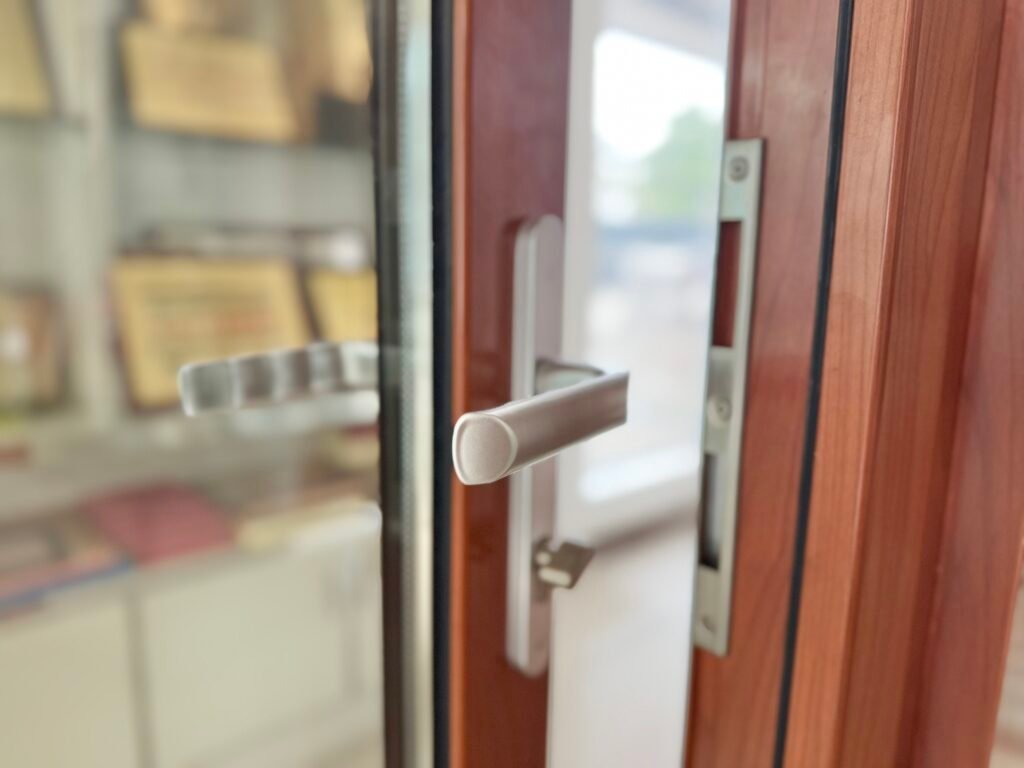
Stop guessing if your handles will wobble in 6 months.
When specifying swing door handles, most buyers focus on aesthetics—the finish, the shape, the backplate design. But the real difference between a handle that lasts 20 years and one that fails in 18 months is invisible once installed: the through-bolt.
A poorly made through-bolt leads to loose handles, stripped threads, door surface damage, and even security breaches. This guide cuts through the marketing and gives you 7 targeted questions to separate high-quality suppliers from the rest.
Why Through-Bolt Quality Matters More Than You Think
Most swing door handles are mounted on two main components: the visible lever/trim and the hidden fixing mechanism. The through-bolt is the long screw that passes completely through the door, connecting the handle on one side to the handle on the other.
- The Real Cost of a Bad Through-Bolt
- A low-quality through-bolt doesn’t just loosen gradually. It causes:
- Door damage: Overtightening a weak bolt strips the thread or cracks the door core.
- Safety risks: Loose handles fail during emergency exit attempts.
- Frequent maintenance: Facilities managers spend hours retightening cheap bolts.
- Surface rust: Non-stainless bolts bleed rust into decorative finishes.
- The key insight: You can’t see the through-bolt on a finished door. That’s exactly why you must ask about it before buying.
- A low-quality through-bolt doesn’t just loosen gradually. It causes:
7 Critical Questions to Ask Every Swing Door Handle Supplier
Use this checklist during supplier negotiations or specification reviews.
- “What material is your through-bolt, and is it corrosion-tested?”
- Why this matters: Many suppliers use zinc-plated steel—fine for dry interiors, but a disaster for coastal areas, washrooms, or exterior doors.
- What a good answer looks like:
- Stainless steel (304 or 316) – 316 for marine/high-humidity environments.
- Clear proof of salt spray testing (e.g., 500+ hours ASTM B117 without red rust).
- Red flag: “It’s steel, but we coat it.” Coatings scratch during installation.
- “What is the tensile strength rating of your through-bolt?”
- Why this matters: Low tensile strength bolts stretch or snap when someone leans on the handle or when the door is slammed.
- What a good answer looks like:
- Minimum Grade 8.8 (metric) or Grade 5 (imperial) for commercial doors.
- The supplier provides a data sheet with N/mm² or PSI values.
- Avoid: “It’s strong enough” without numbers.
- “Does your through-bolt use a full thread or partial thread?”
- Why this matters: A fully threaded bolt in soft wood or composite doors creates a “cheese grater” effect—it chews up the door core over time.
- What a good answer looks like:
- Partial thread (smooth shank where it passes through the door, threads only at the ends).
- Or a fully threaded bolt with a metal sleeve/tube to protect the door interior.
- Why: A partial
- thread allows the bolt to clamp without enlarging the hole.
- “What anti-loosening mechanism do you use?”
- Why this matters: Vibration from daily door slams loosens standard nuts and washers. Eventually, one side of the handle spins freely.
- What a good answer looks like:
- Nylon-insert lock nuts (prevent vibration loosening).
- Serrated flange nuts (bites into the backplate).
- Thread-locking patch pre-applied (e.g., Loctite® patch).
- Avoid: Plain nuts with flat washers only.
- “Is the through-bolt length adjustable for different door thicknesses?”
- Why this matters: Standard door thickness varies (35mm to 50mm interior, up to 70mm fire-rated). A bolt too short gives only 2 threads of grip. Too long and it bottoms out.
- What a good answer looks like:
- Supplier stocks multiple fixed lengths (e.g., 40mm, 50mm, 60mm).
- Or uses an extender system or universal-length bolt with spacers.
- Better: Supplier asks you for your exact door thickness before shipping.
- “What finishes are available for the bolt head and nut? Are they matching?”
- Why this matters: On exposed back-to-back handles, the bolt head or nut is visible. Mismatched finishes look unprofessional.
- What a good answer looks like:
- Bolt head and nut come in matching plated finishes (chromed, matte black, PVD brass, etc.).
- Or a cover cap that matches the handle finish.
- Red flag: “The bolt is hidden anyway.” (No—on many modern backplates, it’s partially visible.)
- “Do you provide a torque specification and installation tool?”
- Why this matters: Without a torque spec, installers overtighten (stripping threads) or undertighten (loose handles).
- What a good answer looks like:
- Clear torque range (e.g., 2.5–3.5 Nm).
- Includes a simple hex key or spanner that limits over-torque by design (e.g., small handle length).
- Best-in-class: Supplier offers a pre-assembled through-bolt kit with color-coded spacers.
How to Visually Inspect Through-Bolt Quality (Without Tools)
You don’t always get to test before buying. But you can check these three things on a sample:
- Thread sharpness – Cheap bolts have rolled threads that look flattened. Quality bolts have cut or ground threads with sharp, uniform peaks.
- Head stamping – A bolt head marked “SS304” or “8.8” is traceable. Unmarked bolts are mystery metal.
- Washer thickness – Thin, flimsy washers (under 1mm) indicate cost-cutting. Quality through-bolts use washers ≥1.5mm thick.
The Bottom Line – A Summary for Smart Buyers
Through-bolts are the skeleton of your swing door handle. Ignoring them means accepting premature failure, safety hazards, and hidden maintenance costs.
Your action plan:
- Ask all 7 questions before issuing a purchase order.
- Reject vague answers like “high quality” or “commercial grade.” Demand materials, test data, and torque specs.
- Test one sample – install it in a spare door cutout. If it wiggles after 100 cycles, switch suppliers.
A good handle set with a poor through-bolt is a bad product. A good through-bolt turns a decent handle into a reliable one.
FAQ
Q1: Can I replace a poor through-bolt later without changing the handles?
A: Sometimes, but rarely. Many handle designs use proprietary bolt lengths or non-standard thread pitches. Always buy spares from the original supplier. For universal handles (e.g., US 2-3/4” backset), you can source aftermarket bolts—but match the grade and material carefully.
Q2: Are through-bolts necessary for narrow stile glass doors?
A: No. Glass doors use different fixing systems (e.g., clamp mounts or glass drilling). Through-bolts are for solid core doors—wood, composite, metal, or hollow metal reinforced.
Q3: My handle is loose after 2 years. Is it the through-bolt or the handle?
A: Likely the through-bolt. Remove the cover plate. If the nut is still tight but the lever wobbles, the bolt has stretched or the door core has compressed. If the nut spins freely, the lock nut failed. In both cases, replace the bolt with a higher-grade version.
Q4: Do fire-rated doors require special through-bolts?
A: Yes. Fire door regulations (e.g., UL 10C in the US, BS 476 in the UK) often require the through-bolt to not reduce the door’s fire resistance. Use only bolts marked for fire door use—typically steel with intumescent sleeves or washers.
Q5: How often should I retighten swing door handle through-bolts?
A: In commercial settings (high traffic), check every 6 months. In residential, every 2–3 years is fine if high-quality lock nuts are used. If you’re tightening more than once a year, the bolt or nut is substandard.
Q6: What’s the difference between a through-bolt and a sex bolt (a.k.a. barrel nut)?
A: A standard through-bolt is a long screw with a nut at the end. A sex bolt (barrel nut) has a smooth, threaded barrel on one side and a screw on the other. Sex bolts are often better for hollow metal doors because the barrel reinforces the hole. Ask your supplier which type they use.
Q7: Does a higher price guarantee better through-bolt quality?
A: Not automatically. Some premium handle brands use the same commodity bolts as budget brands. You must ask the 7 questions regardless of price. Expensive ≠ engineered.
Final takeaway: The next time you spec or buy swing door handles, spend 90% of your quality check on the part you can’t see—the through-bolt. Your future self (and your maintenance team) will thank you.