


Introduction
With the development of the global construction industry and the acceleration of urbanization in the Middle East, Bahrain, as an important commercial and financial center in the Gulf region, is experiencing a continuous increase in demand for high-quality building materials and accessories. Aluminum window hardware, as a key component of modern architecture, directly impacts the progress and quality of construction projects due to the stability and efficiency of its supply chain. China, as the world’s largest producer and exporter of aluminum window hardware, possesses a complete industrial chain and cost advantages; however, efficiently and reliably transporting products to Bahrain to meet local market demands presents a complex challenge. This article will delve into aluminum window hardware supply chain solutions from China to Bahrain, analyzing key links, challenges, and optimization strategies to provide a practical guidance framework for relevant enterprises.
Part 1: Market Background and Opportunities Analysis
- 1.1 Overview of the Bahrain Construction Market
- Although Bahrain is a small country, as a member of the Gulf Cooperation Council (GCC), its construction and real estate industries remain active. The government’s “Economic Vision 2030” plan aims to diversify the economy, with infrastructure construction and residential and commercial real estate development as key areas. New construction projects and urban renewal projects in cities such as Manama and Rifa are constantly emerging, driving demand for imported building materials.
- Aluminum window systems are widely used in Bahrain’s construction due to their lightweight, corrosion resistance, and adaptability to high-temperature climates. With increasing energy-saving and environmental protection standards, the demand for high-performance aluminum window hardware is growing, including multi-point locking systems, hinges, handles, and pulleys.
- 1.2 Advantages of China’s Aluminum Window Hardware Industry
- After decades of development, China’s aluminum window hardware industry has formed major industrial clusters in Guangdong, Zhejiang, Jiangsu, and Shandong, capable of providing a full range of products from economy to high-end customized options. The advantages of “Made in China” lie not only in cost competitiveness but also in rapid response, technological innovation, and large-scale production capabilities. Many Chinese companies have obtained international certifications (such as ISO, QB/T, etc.), and their product quality meets European and American standards, which is suitable for the Bahrain market’s demand for a balance between quality and price.
Part Two: Key Links and Challenges in the Supply Chain
- 2.1 Procurement and Quality Control
- Pain Points:
- Dispersed suppliers with inconsistent quality
- Differences between specifications and the Bahrain market requirements
- Low communication efficiency, difficulty in meeting customised needs
- Solutions:
- Establish a systematic supplier evaluation system, focusing on production capacity, certifications, and export experience.
- Clearly define technical parameters, material standards, and inspection requirements (such as salt spray test cycles, load-bearing capacity, etc.) in procurement contracts.
- Utilise third-party quality inspection services (such as SGS, BV) for testing during production and before shipment to ensure compliance with Bahrain standards (such as GCC standards or European EN standards).
- Leverage digital tools (such as video factory audits, real-time production tracking systems) to improve communication efficiency.
- Pain Points:
- 2.2 Packaging and Warehousing Optimisation
- Pain Points:
- Hardware accessories are easily damaged or corroded during transportation.
- Inadequate packaging leads to low loading and unloading efficiency.
- Improper inventory management results in capital tied up.
- Solutions:
- Use rust-proof packaging (VCI rust-proof paper, rust-proof bags) and shock-resistant linings to adapt to the maritime environment.
- Design standardised packaging modules to maximise container space utilisation and facilitate mechanised loading and unloading.
- Establish consolidation warehouses near major Chinese ports (such as Shenzhen, Ningbo, and Shanghai) to integrate products from multiple suppliers and reduce transportation costs.
- Implement an inventory early warning system to schedule production and delivery based on order forecasts and safety stock levels.
- Pain Points:
- 2.3 International Transportation and Logistics Options
- 2.3.1 Sea Freight: Mainstream Options Analysis
- Route: Major Chinese ports (Shanghai, Ningbo, Shenzhen) → Khalifa Bin Salman Port, Bahrain
- Transportation Time: Typically 18-28 days, depending on the port of origin and the shipping company’s route.
- Cost Composition: Ocean freight, THC, document fees, insurance, etc.
- Precautions: Avoid improper packaging during the hot summer months to prevent condensation and corrosion; confirm Bahrain customs clearance requirements (e.g., certificate of origin, test reports, etc.).
- 2.3.2 Air Freight and Multimodal Transport
- Air Freight: Suitable for urgent orders or high-value products; the cost is approximately 4-6 times that of sea freight, but it can reduce transit time to 3-7 days.
- Sea-Air Intermodal Transport: Transit via Dubai or Abu Dhabi, balancing time and cost.
- China-Europe Railway Express + Sea Freight: Transit via rail to Europe and then to Bahrain; transit time is between sea and air freight.
- 2.3.3 Logistics Partner Selection Criteria:
- Has a branch office or a reliable agent network in the Middle East
- Has experience handling building materials goods
- Provides an end-to-end tracking system and timely information updates
- Able to assist with customs clearance and last-mile delivery
- 2.3.1 Sea Freight: Mainstream Options Analysis
- 2.4 Bahrain Customs Clearance and Regulatory Compliance
- Key Requirements:
- Commercial invoices, packing lists, and bills of lading/air waybills must be accurate and complete.
- Certificate of Origin (usually requires certification from the Chinese Chamber of Commerce).
- Certificate of Conformity (CoC): Some products may require GCC certification.
- Trademark Registration Check: Ensure products do not infringe on locally registered trademarks.
- Tariff Policy: Bahrain’s tariffs are generally low (0-5% for most products), but the latest rates need to be confirmed.
- Customs Clearance Optimisation Strategies:
- Work with experienced local customs clearance agents and prepare documents in advance.
- Understand the specific requirements of the Bahrain Standards and Metrology Bureau (BSMD) for building products.
- Consider establishing a warehousing and distribution centre in a Bahrain Free Trade Zone (such as the Bahrain Logistics Zone) to enjoy tax incentives and flexible distribution.
- Key Requirements:
- 2.5 Last-Mile Delivery and Local Services
- Challenges:
- Bahrain’s local logistics infrastructure is relatively well-developed, but last-mile delivery efficiency needs optimisation.
- Customer demand for installation support and technical services.
- Timeliness of returns, exchanges, and after-sales spare parts supply.
- Solutions:
- Establish partnerships with local building material distributors or hardware stores, leveraging their existing channels.
- Deliver directly to construction sites for large projects, reducing intermediaries.
- Provide installation guides and technical parameter sheets in English and Arabic.
- Establish a small spare parts warehouse in Bahrain to support rapid after-sales response.
- Challenges:
Part 3: Digitalization and Supply Chain Innovation
- 3.1 Supply Chain Visualization Platform
- Through Internet of Things (IoT) sensors and blockchain technology, achieve end-to-end visualization from the Chinese factory to the
- Bahrain construction site:
- Real-time monitoring of cargo location, temperature, and humidity conditions
- Automatic early warning of abnormal situations (such as delays, environmental exceedances)
- Digitalized document flow, reducing paper document delays
- 3.2 Demand Forecasting and Intelligent Inventory Management
- Utilizing historical data and machine learning algorithms:
- Predicting seasonal demand changes in the Bahrain market (such as the impact of Ramadan, reduced summer construction, etc.)
- Dynamically adjusting safety stock levels and replenishment plans
- Reducing stockout risks and inventory backlogs
- Utilizing historical data and machine learning algorithms:
- 3.3 Sustainable Supply Chain Practices
- Optimizing packaging materials, using recyclable or biodegradable materials
- Selecting transportation methods and shipping companies with lower carbon emissions
- Promoting aluminum window hardware recycling and reuse programs in Bahrain, in line with ESG trends
Part Four: Risk Management and Cost Control
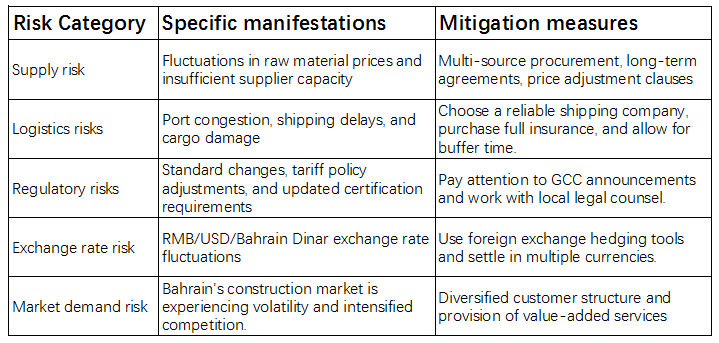
- 4.1 Major Risk Types and Countermeasures
- 4.2 Cost Optimization Strategies
- Transportation Costs: Optimize through Less-than-Container Load (LCL) or Full Container Load (FCL) freight rates, and secure freight discounts through long-term contracts.
- Inventory Costs: Implement Vendor Managed Inventory (VMI) or Just-In-Time (JIT) delivery models.
- Customs Costs: Fully leverage the outcomes of the China-GCC Free Trade Area negotiations (if an agreement is reached).
- Finance Costs: Utilize supply chain finance tools, such as accounts receivable factoring and inventory financing.
Part 5: Success Stories and Practical Recommendations
- 5.1 Case Study: A Guangdong Hardware Company Successfully Enters the Bahrain Market
- Background: The company specializes in producing high-end aluminum window multi-point locking systems and hopes to expand into the Middle East market.
- Strategy:
- Established an exclusive agency relationship with a local Bahrain building materials importer.
- Adjusted surface treatment processes (increased coating thickness) according to Bahrain’s high temperature and humidity environment.
- Established a regional distribution center near a Chinese port, integrating products from multiple suppliers.
- Used rust-proof packaging and desiccants to ensure product condition after sea freight.
- Provided Arabic technical support and installation training videos.
- Results: Within 6 months, market share reached 15% of local imported brands, and the customer complaint rate was less than 2%.
- 5.2 Practical Recommendations for Enterprises
- Market Entry Stage:
- Participated in the Bahrain International Building Exhibition (BIG5), Bahrain: Direct Customer Engagement
- Start with small-batch trial orders to test logistics and market demand.
- Obtain local product certifications and customer feedback for rapid product iteration.
- Growth Phase:
- Consider establishing a representative office in Bahrain or forming a joint venture with a local partner.
- Develop customized products that meet Bahrain’s building codes (such as fire safety requirements).
- Establish a local brand image and after-sales service network.
- Maturity Phase:
- Use Bahrain as a regional distribution center to serve surrounding markets such as Saudi Arabia’s Eastern Province and Qatar.
- Introduce smart manufacturing and flexible production to handle small-batch, multi-variety orders.
- Implement a fully digital supply chain to maximize end-to-end efficiency.
- Market Entry Stage:
FAQ
Q1: How long does it typically take to ship aluminum window hardware from China to Bahrain by sea?
A1: The standard sea freight time is approximately 18-28 days, depending on the port of origin (South China ports are usually faster), the shipping company’s route, and seasonal factors. It is recommended to allow a 10-15-day buffer period to account for potential delays.
Q2: What certification requirements does Bahrain have for imported aluminum window hardware?
A2: Bahrain mainly follows the GCC unified standard. Key products may require a GCC Certificate of Conformity (CoC) to prove that the product meets safety and performance standards. In addition, certificates of origin and third-party testing reports (such as material analysis and salt spray test reports) are also commonly used documents for customs clearance.
Q3: How to prevent hardware accessories from rusting during sea freight?
A3: It is recommended to use VCI (vapor phase corrosion inhibitor) packaging, rust-preventive oil treatment, and sealed moisture-proof packaging. Place desiccants inside the container to avoid condensation caused by drastic temperature changes. Inquire about container ventilation conditions when choosing a shipping company.
Q4: What are the main distribution channels for aluminum window hardware in Bahrain?
A4: Main channels include: building materials wholesale markets (such as the Manama Building Materials Market), professional hardware importers, direct procurement by construction contractors, and designated procurement by real estate developers. In recent years, e-commerce platforms (such as Amazon.sa and local e-commerce platforms) have also gradually become supplementary channels.
Q5: What are the import tariffs on aluminum window hardware from China to Bahrain?
A5: Bahrain’s overall tariff level is relatively low, with tariffs on most hardware products ranging from 0-5%. However, it is necessary to confirm the specific HS code and corresponding tax rate, and pay attention to any potential anti-dumping duties (if any).
It is recommended to obtain the latest information through the Bahrain Customs website or by consulting a customs clearance agent.
Q6: How to handle after-sales parts supply and returns/exchanges?
A6: It is recommended to establish a small spare parts warehouse in Bahrain to store commonly used and easily damaged parts. Cooperate with local service providers to provide technical support. The return/exchange policy should be clearly stated in the sales contract.
Consider establishing a dedicated warehouse in China to handle overseas returns and store repairable products.
Q7: What are the specific applications of digital tools in the supply chain?
A7: Includes: a supply chain visualization platform (real-time cargo tracking), ERP system integration (order and inventory management), Electronic Data Interchange (EDI) to expedite customs clearance document processing, and a customer portal (allowing Bahrain customers to independently check order status and technical information).
Q8: How to balance transportation costs and delivery time?
A8: A hybrid strategy can be adopted: regular orders are shipped by sea, and urgent orders are shipped by air, or multimodal transport (China-Dubai air freight + Dubai-Bahrain land freight). Through demand forecasting, high-turnover products are pre-stocked in local Bahrain warehouses.
Summary
Establishing an efficient and reliable aluminum window hardware supply chain from China to Bahrain requires systematic thinking and meticulous operation. Companies should fully understand the unique requirements and potential of the Bahrain market and professionally plan every aspect, from supplier selection and quality control to packaging optimization, logistics and distribution, and local services. This includes enhancing transparency through digital tools, ensuring stability through risk management, and strengthening competitiveness through cost control. The key to success lies not only in the quality and price of the products themselves, but also in the collaborative efficiency and adaptability of the entire supply chain.
With the advancement of Bahrain’s Vision 2030 and the continued development of the regional construction market, Chinese aluminum window hardware companies have significant opportunities. Those companies that can build flexible, responsive, and sustainable supply chains will not only be able to establish themselves in the Bahrain market but also use Bahrain as a hub to expand into the vast markets of the entire Gulf region. Ultimately, the supply chain will no longer be a cost center but will become a core part of differentiated competitive advantage and customer value creation.